Brief History.
In the usual way that the word is used, Kālacakra refers to one of the main Tantric
deities of Vajrayāna Buddhism. However, in a wider sense the word refers to the whole collection of philosophies and meditation practices contained in a set of texts based around the Kālacakra Tantra.
The Kālacakra Tantra is more properly called the Kālacakra Laghutantra, as it
is said to be an abridged form of an original text – the Kālacakra
Mūlatantra.
It is said by the Tibetan historian Tāranātha, that the Mūlatantra was taught
by the Buddha on the full moon of the month Caitra in the year following his
enlightenment, at the great stupa of Dhānyakaṭaka (dpal ldan 'bras spungs kyi mchod rten) in India. This teaching had been requested by the king Sucandra from Sambhala (often written "Shambhala".
In original Sanskrit texts the form is usually equivalent to "Sambhala", but in
Tibetan texts it is written equivalent to "Shambhala".)
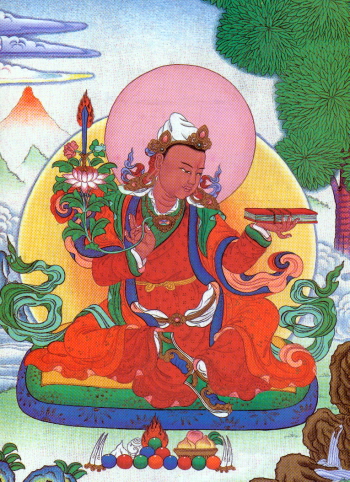 |
Mañjuśrī Yaśas, said to be the author
of the Kālacakra
Laghutantra |
Sucandra returned to Sambhala and wrote the Tantras in textual form there. He
composed the explanatory Tantra in 60,000 lines as a commentary on the original
Mūlatantra of 12,000. A later king of Sambhala, Yaśas, wrote the abridged form
of the Tantra, the Kālacakra Laghutantra. This is about one quarter of the
length of the original Mūlatantra. This text survives today, and is generally
known simply as the Kālacakra Tantra.
The next king was Puṇḍarīka, and he composed a commentary on the Laghutantra
known as the Vimalaprabhā. This also survives to this day, and both these texts
are available in the original Sanskrit and Tibetan translation. However, the
original Mūlatantra, if it ever existed, has been lost, although significant
sections remain in quotations in the Vimalaprabhā and some other texts. The
existence of these quotations does not of course prove that the Mūlatantra ever
existed as a complete text.
Having been preserved in Sambhala for many centuries, the teachings of the Kālacakra cycle were brought into India around the middle of the 10th century. Roughly 60 years later, in 1027, the Kālacakra was introduced into Tibet. Naturally, the period of translation and adoption lasted a couple of hundred years, and the significance of the date 1027 is that the new Tibetan chronology, based on the Kālacakra system, started in that year.
Among the early teachers of the Kālacakra in Tibet, two, who happen to be almost exact contemporaries, are normally agreed to stand out: Dolpopa Sherab Gyaltsen (1292-1361) and Buton Rinchen Drup (1290-1364). Kālacakra is practised my most of the different traditions within Tibetan Buddhism, but the two
foremost are the Gelug, based largely on the teachings of Buton, and the Jonang, based on Dolpopa.
The Kālacakra teachings.
The general content of the teachings of Kālacakra are usually categorised in two
ways. First by ground, path and result, and second by inner, outer and other. The categories of ground, path and result are common to many Buddhist tantric systems, but the inner, outer and other division is peculiar to
Kālacakra.
The ground is essentially the normal state that beings find themselves in. Buddhism states that the essential characteristic of that state is suffering, and so the ground covers the Buddhist theory of why this suffering exists, how that state is maintained, and of course, how within that state there exists the potential to overcome the causes of suffering and achieve enlightenment.
The path is the description of the practices that are to be followed in order to remove the causes of suffering and achieve enlightenment. The result – some maintain that perhaps "goal" is a better translation – is the state of enlightenment once the causes of suffering have been completely removed.
This classification of the contents of the Kālacakra system into ground, path and result, and the division into inner, outer and other, correspond to different chapters of the Kālacakra Tantra. In other words, the Kālacakra system is explained in the Tantra in this structured manner.
The Kālacakra Tantra is divided into five chapters. The first chapter deals with the outer Kālacakra: the physical world, in particular the calculation system for the Kālacakra calendar. It also covers the basic symbolism of the Kālacakra system and describes a set of machines, ranging from catapults and an irrigation machine to a merry-go round for use at the spring festival!
The second chapter deals with inner Kālacakra, and covers the inner world of human existence, dealing with the processes of gestation and birth, the classification of the functions within the human body and experience, and the vajra-kāya – the expression of human physical existence in terms of channels, winds, drops and so forth. In particular, human existence is described as consisting of four states: the waking state, dream, deep sleep, and the so-called fourth state, which mainly refers to orgasm. The potentials (drops) which give rise to these states are described, together with the processes that flow from them. These first two chapters comprise the ground Kālacakra, describing the state of human existence as it is.
The next three chapters describe the other Kālacakra and deal with the path and result. The third chapter deals with the preparation for the meditation practices of the system, the initiations of Kālacakra. There are two main sets of initiations in Kālacakra. The first of these is the preparation for the generation process meditations of Kālacakra. This set of initiations is known as the Seven Empowerments Raising the Child (byis pa la 'jug pa'i dbang bdun). The point of this name is that the generation process (often misleadingly called a "stage") meditation purifies the process of life, from the moment of conception up to the stage of puberty. In the initiation, the student is introduced to this process by the teacher, who guides the student through the basic process from conception, through gestation, birth, learning to talk, and so forth, up to maturity. This first set of initiations requires the use of the Kālacakra powder maṇḍala, and this
is therefore described in the third chapter.
The next set of initiations is known as the "Higher Empowerments" (dbang gong ma), and symbolically purifies the process of life after puberty. For this reason, there is much sexual imagery in these empowerments. They specifically prepare the student for the perfection process meditations of Kālacakra, known as the Six
Yogas.
The fourth chapter explains the actual meditation practices themselves: both the meditation on the maṇḍala and deity of Kālacakra in the generation process, and the perfection process of the Six Yogas. These two chapters, three and four, thereby describe the path of Kālacakra.
The final fifth chapter describes the state of enlightenment that results from the practise of that path, and thereby covers the result Kālacakra.
|