|
There is very little discussion of actual meditation practice on this site, and certainly no explanation how such practices should be performed. Similarly, there are no practice texts (sādhanas, pūjas, and so forth) available here for download, as availability of such materials is not only pointless without guidance and instruction from a qualified teacher, it would potentially be harmful. Such guidance simply cannot be provided by a website, even with some kind of registration process, and anybody interested in practising Kālacakra, or any other Vajrayāna (rdo rje'i theg pa) practice, should first seek out a qualified teacher, if they are not already in touch with one. That teacher can then provide directly or indirectly the
necessary practice materials, and sites such as this can hopefully provide useful or interesting support and reference information.
This site is therefore intended to provide background and otherwise hopefully interesting information, for the benefit of people who are actually practising Kālacakra or who have a general interest in Kālacakra. An internet site is a wholly inappropriate forum for the discussion of the details of meditation practices.
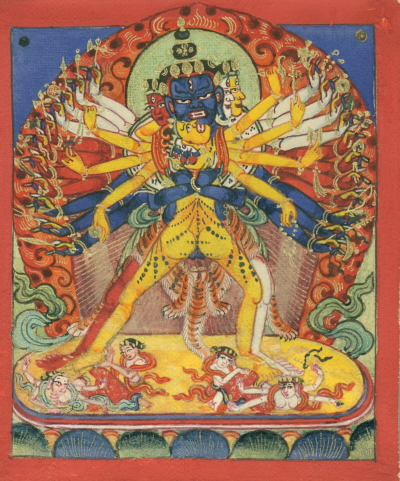 |
Gelugpa tsakali of Kālacakra, from Mongolia,
c1940s. Provided by David Templeman after purchase
from Suzy Lebasi, Sootze Orientique. |
Kālacakra has a somewhat special position within Vajrayāna practices, but the
general methods of such practices are followed with Kālacakra. First, as
stated above, it is important that these practices are performed only under the
guidance of a qualified teacher (lama). There are several reasons for this,
perhaps the most important being that one should be guided by somebody who
themself already has considerable experience in the type of practices being
performed. It is surprisingly easy to get these things wrong, to practise in a
way that either has no benefit at all, or is even confusing or perhaps harmful
in some way.
There is also a generally accepted order in which practices are learned and
performed. Major Vajrayāna yidam practices such as Kālacakra require very
careful, and very thorough preparation, which may take several years, before
the main practice is commenced. This is important for the practices to be
properly effective. This degree of preparation may well vary from individual to
individual, but such variations can only be judged by a qualified
teacher.
All the major traditions have particular sets of preliminary practices
(sngon 'gro) which are performed before the yidam practice. It does not
really matter which tradition of these is performed, as their content is very
similar. H.H. Dalai Lama was asked some years ago if he would consider writing
a Ri-me set of preliminary practices (meaning not affiliated with any
particular tradition). His reply was that there was no shortage of preliminary
practices, but the problem was that there were not enough people performing
such preliminaries.
The basic structure of these preliminaries consists of several steps. Often the
first are a set of four meditations that are sometimes called the ordinary
preliminaries, or the four meditations to change attitudes. These are the
contemplation of: 1) the difficulty of obtaining the freedoms and conditions,
in other words the precious human existence and the valuable opportunity this
presents for practice; 2) the recollection of death and the transitory nature
of existence and all phenomena; 3) examining the ways in which actions mature
into results, often called in the west the "law of karma"; and, 4) the
viciousness of cyclic existence, the suffering that is experienced by beings
not on the path to enlightenment. These meditations are intended to provide a
strong and proper motivation for practice, a stable sense of renunciation; the
understanding that there is nothing to be gained from cyclic existence and the
determination to act to achieve liberation from that existence.
After these meditations come what are sometimes called the special preliminaries (thun mong ma yin pa'i sngon 'gro). First is the contemplation of refuge, the very basis of the path of Buddhism. Next is the development of the enlightened attitude, the basis of the Mahāyāna path on which one acts not only for oneself, but is motivated by the wish to bring all beings to enlightenment. Next is purification by means of Vajrasattva (rdo rje sems dpa') meditation, the intention being to purify the results of harmful acts committed in the past, to remove the resulting obscurations, defilements and dispositions. The path is often described as consisting of the development of the two accumulations, of merit and understanding, and this is the purpose of the next preliminary, the maṇḍala offering. Finally, there is guruyoga (bla ma'i rnal 'byor) meditation, to develop the true inspiration of the Vajrayāna path.
These practices usually entail the repetition of 100,000 verses or mantras within each meditation, including performing 100,000 prostrations with the meditation on refuge. In specific Kālacakra preliminaries a further practice on the two-armed form of Sahaja Kālacakra is also included.
Although there are many variations, most traditions consider such a set of practices to be the minimum before yidam practice is commenced. Some add, for example, two or three additional guru yoga practices, and many place considerable emphasis on the development of silent meditations such as samatha (zhi gnas) and vipaśyanā (lhag mthong). Completing these preliminaries is not the end of such practice. The importance of these preliminaries cannot be overstated.
| Translation note: three freedoms, dben pa gsum: People are often telling me that the correct term here should be "three solitudes", or some such, presumably because this is usually the first word you come across in a dictionary; the meaning in that sense refers to something like a remote, empty area, somewhere peaceful and quiet. However, in the context of meditation, sentences like the following would be absurd if that term were used: "The three freedoms are the freedom of the body from activity, freedom of the speech from talking and freedom of the mind from thoughts". |
One point that should be emphasised very clearly is that one never stops performing preliminary practices – they are not something to be gone through and then you get onto the "serious stuff". In the Karma Kagyu tradition, for example, after yidam practice when the practitioner is practising the Six Dharmas of Nāropa, each session starts with a set of preliminary practices, refuge, etc.
In the Jonang Kālacakra tradition, the preliminaries are considered to be preliminaries to the perfection process meditation, the Six Yogas. The terminology is a little different, in that there are five ordinary preliminaries: refuge, development of the enlightened attitude, Vajrasattva, maṇḍala and guruyoga; there are then two special preliminaries: the generation process of two-armed Sahaja Kālacakra and the "three freedoms" (dben pa gsum). This Sahaja Kālacakra meditation can be used as the approach (see below) for the yidam practice.
Once yidam practice has been started, with Kālacakra there are several different scales of practice. Many entail a maṇḍala with 24-armed Kālacakra in the centre. The Gelug tradition has a particularly interesting guruyoga which focuses on 24-armed Kālacakra, and can be considered to fall within the preliminary category.
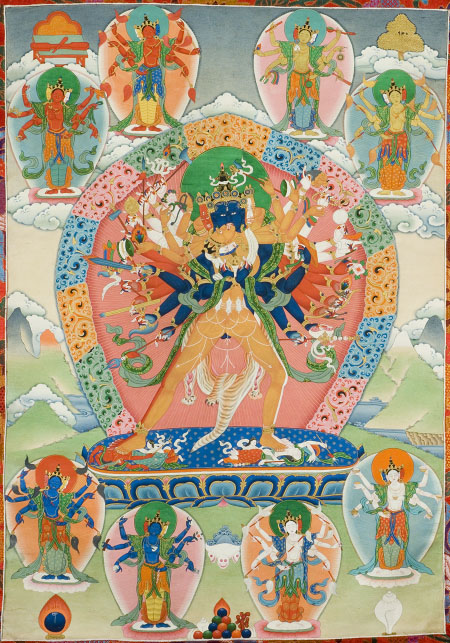
| | The deities of the nine-deity practice. This thangka is in the possession of Benchen Monastery, Kathmandu, and was commissioned in Jyekundo, eastern Tibet. Clicking on the image will bring up a high resolution copy, suitable for printing. |
For daily practice, many would continue to use a two-armed Kālacakra practice, or something like a nine-deity maṇḍala practice, in which 24-armed Kālacakra is surrounded by the eight śaktīs (nus ma brgyad) and four emblems (see the image on the right). The next most extensive form of practice is a mind-maṇḍala practice, in which the central lotus is surrounded by four buddhas and their consorts, six bodhisattvas and their consorts, and certain wrathful deities and offering goddesses. This could be used as a daily practice, but is mainly used as a retreat practice.
Finally, there is the full triple body, speech and mind maṇḍala practice of
Kālacakra, entailing the full maṇḍala of 636 or 722 deities
(depending on tradition). This is usually only used for major rituals and
initiations. Naturally, all of these practices have associated with them
various offering rituals and Tsog (tshogs) rituals that can also be
performed.
| Translation note: approach, bsnyen pa: This very simple word seems to produce quite some difficulties. One often hears of "the approximation" or "approximation retreat" in this context. The definition is quite simple: it is like coming into the presence of an important person whose permission is needed for some project and putting one's case. For example, in a modern context, one may meet with a bank manager in order to put the case for borrowing money to buy a car. We would say that you "approach" your bank manager, or, make "an approach" to the manager. I am not sure what my bank manager would think if I tried to "approximate" him. Where such bizarre translations come from is truly a wonder! |
Although there are many descriptions given for the completion of the generation
process practice of Kālacakra, a rule of thumb is usually given in terms of a
minimum number of mantra repetitions. A figure that is often seen is that the
so-called "approach" (bsnyen pa) of the generation process is completed
after a repetition of 10 million Kālacakra mantras. That does not mean that one
necessarily then stops doing it. Again, this is a minimum requirement, before
one can start practising the Six Yogas of Kālacakra, although some consider it
beneficial to practise both generation and perfection process meditations
together, once a sufficient grounding has been achieved in the former. Again,
this is an area where a qualified teacher is necessary in order to make such
judgements.
Kālacakra stands out from other major Vajrayāna practices in that it is said to
represent the most advanced and most effective form of Vajrayāna practice, and
yet its initiation (or at least a major part of it) is often given to large
public gatherings. This tradition reputedly goes back to the Jonang master,
Dolpopa, and of course is most famously carried on today by H.H. Dalai
Lama.
Such an initiation is given mainly as a blessing for the majority of those
attending, although there will always be many present for whom the initiation
is an important aid in their personal practice. But this public giving of an
initiation does not mean that relative beginners or people unfamiliar with
Buddhist practice should then get involved with some advanced form of Kālacakra
meditation. The same methods and procedures still apply, and anybody who is
inspired to Buddhist meditation by attending such an event, should of course
first seek out a qualified teacher and follow the usual path of
practice.
Last updated 10 September 2015.
Return to Home Page.
|