|
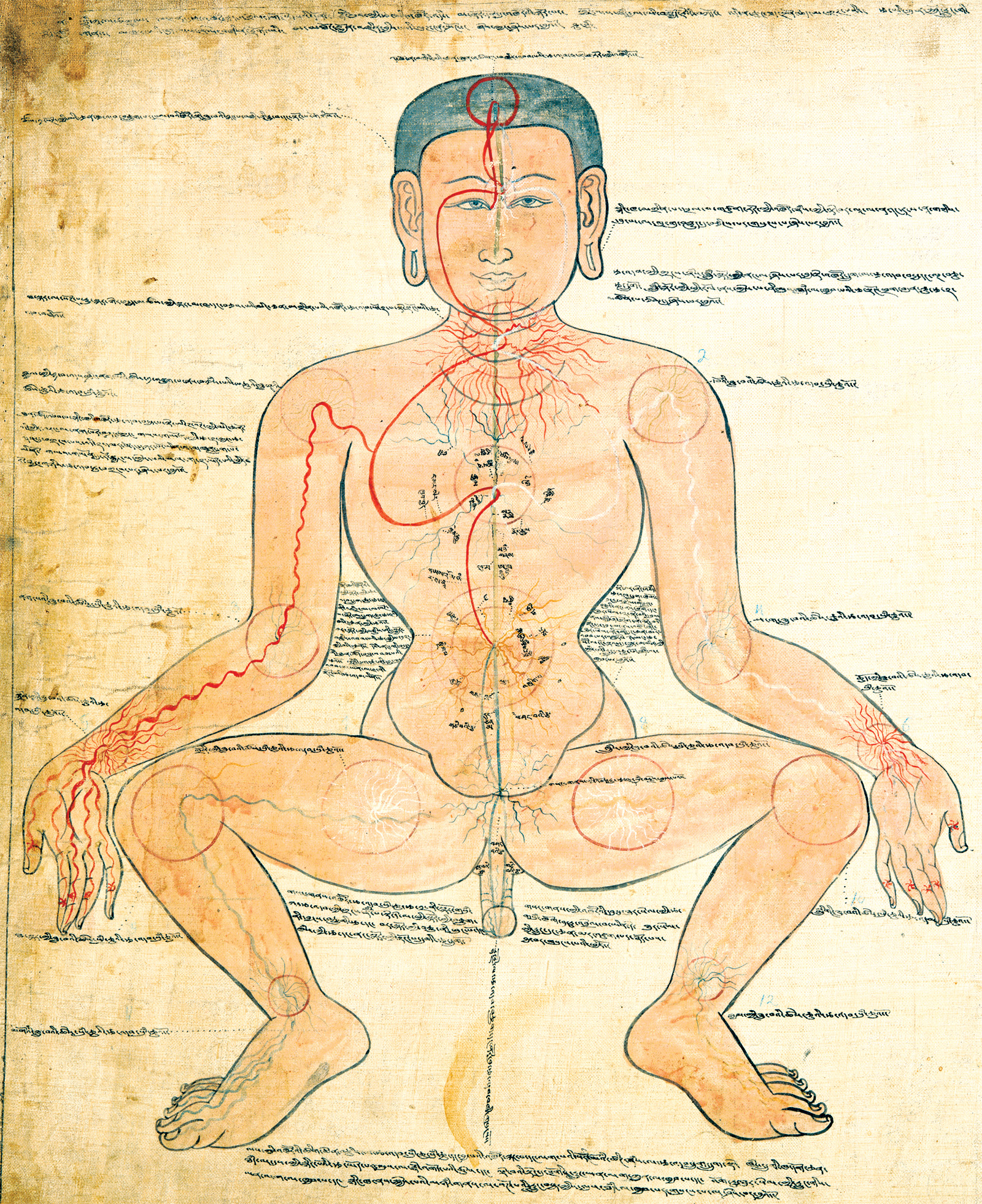
| The second of the two images depicting the channels and centres |
Inner Kālacakra
The channels and centres, part 2
Previous Page
The second of these two paintings that depict inner Kālacakra is more complex than the first. It gives astrological correspondences, both with the zodiac and lunar mansions as well as some other divisions of time. It also shows the positions of the main winds that move in the various channels.
The first thing to notice is that this painting shows the three main channels: the central channel (dbu ma, madhyamā), the red rasanā (ro ma) on the right, and the white lalanā (rkyang ma) on the left. The central channel is normally considered either to be green or blue – quite which colour is intended here is unclear.
|
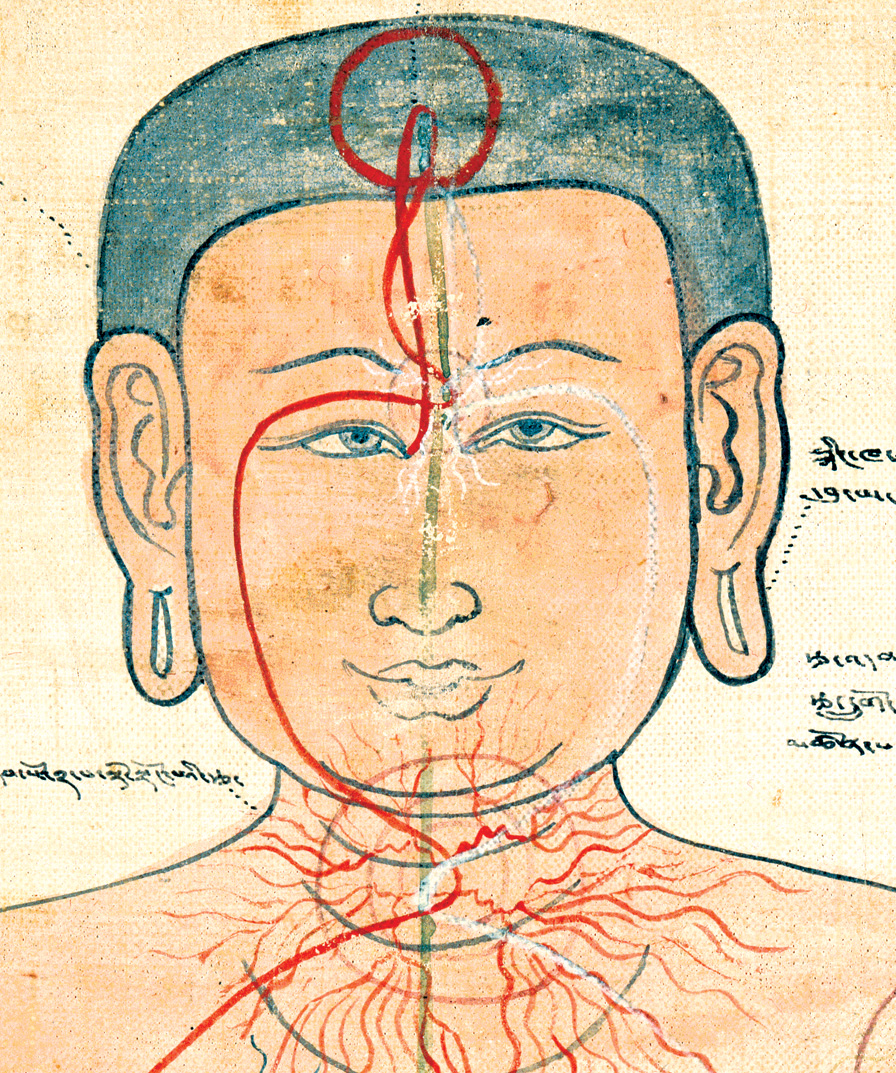
| The channels of the head |
In the meditation practices, the rasanā and lalanā are considered to be straight and parallel, but in this context they twist around the central channel at the level of the centres. The text next to the left ear describes how the two channels are said to link around the central channel, at the middle of the heart, throat, forehead and crown centres.
The red lalanā is clear enough in the close-up on the left, but the white lalanā is rather indistinct. Clicking on the image will bring up a higher resolution version which has been computer enhanced in order to make the lalanā at least a little more clear. These channels reach up to the top of the head, and then bend down to reach the point between the eyebrows.
Also indicated on the painting is the association of the four channels of the crown centre with the four junctures (thun mtshams, prahara) of a day and the sixteen channels of the forehead centre with the sixteen lunar days (tshes pa, tithi). The writing by the throat centre indicates the association of the 32 channels of that centre with the 28 lunar mansions (rgyu skar, nakṣatra) together with four daṇḍa constellations (elsewhere, the other four channels are said to be empty). (v.57.)
The writing by the left ear states that in the middle of the centres of heart, throat, forehead and crown, the rasanā and lalanā channels are linked with the central channel – they are seen here as looped around the central channel.
Just underneath that, by the lobe of the left ear, it is stated that the six centres have a total of 156 channels – this is refering to the outermost channels of each. From the ends of these branch the 72,000 channels that spread throughout the whole body. Clearly these cannot be drawn, but the texts states that these are suggested in the painting by channels spreading from the ends of the main centre channels.
|
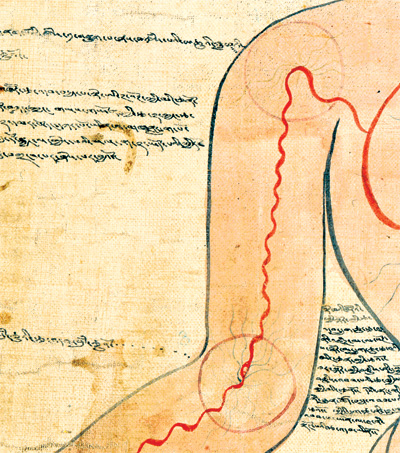
| The right shoulder and elbow |
In the image on the right are seen the centres in two of the joints: those of the right shoulder and elbow. Essentially the same information is given here as in the previous painting, although it is expressed a little differently. The 30 channels of the right shoulder are associated with the 30 lunars days of the month of Māgha (mchu'i zla), during which the Sun leaves the sign of Capricorn. The 30 channels of the elbow are associated with the lunar days of the month of Caitra (nag pa'i zla), during which the Sun leaves the sign of Pisces. And so on for the rest of the main joints:
Right wrist: Jyeṣṭha (snron). Left shoulder, elbow and wrist: Phālguna (dbo), Vaiśākha (sa ga) and Āṣāḍha (chu stod). Right hip, knee and ankle: Śrāvaṇa (gro bzhin), Āśvina (tha skar) and Mārgaśīrṣa (mgo). Left hip, knee and ankle: Bhādrapada (khrums), Kārtikka (smin drug) and Pauṣa (rgyal).
It is clear from the text that it is refering to waning-first (mat ngo sngon 'gro) months. For the right shoulder it states that it startes with the first lunar day of the dark (waning) fortnight following the full Moon of the month of Pauṣa – this would end with the full Moon of the month of Māgha at the end of the white (waxing) fortnight. (The text actually states that the month extends through the 10 days of the month of Māgha; this is clearly an error, and it should read 15.)
|
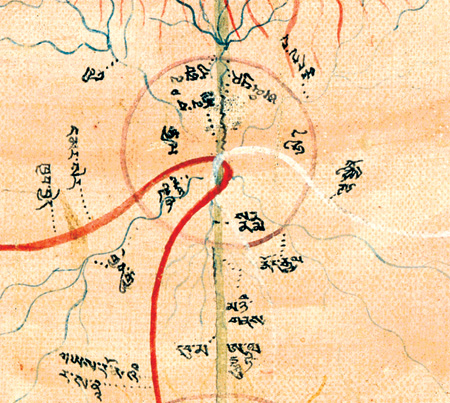
| The channels and winds of the heart centre |
In the image on the left are named the winds that move in the eight channels of the heart centre. They are arranged with east to the bottom, and so, going in a clockwise direction (v.42.) from the point of view of this image, the winds are, together with the elements associated with them:
E: samānavāyu (mnyam gnas) – wind
SE: udānavāyu (gyen rgyu) – fire
S: vyānavāyu (khyab byed) – water
SW: nāgavāyu (klu) – awareness
W: kūrmavāyu (rus sbal) – wind
NW: kṛikaravāyu (rtsangs pa) – fire
N: devadattavāyu (lhas byin) – water
NE: dhanañjayavāyu (nor rgyal) – earth
There are considered to be ten main winds, and of the other two, prāṇavāyu (srog, space) moves in the central channel above the navel, and apānavāyu (thur sel, earth) in the central channel below the navel. These are the main places where these winds are considered to exist. In fact, all ten winds are considered to permeate the whole body.
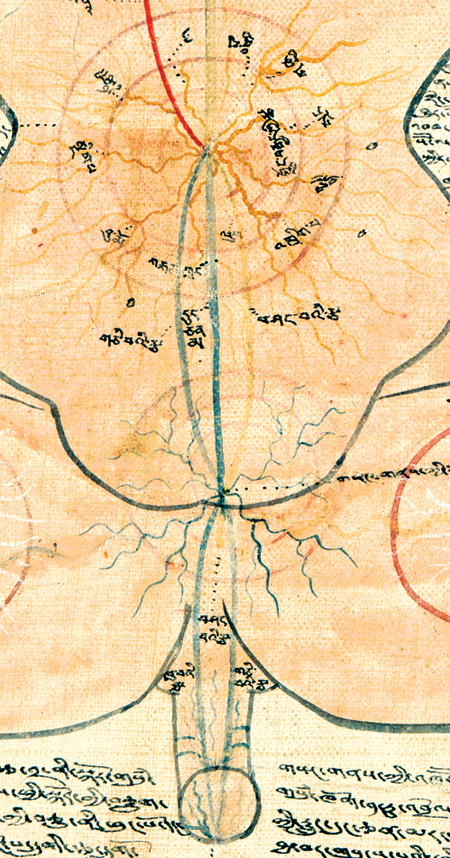
|
| The channels of the navel and genital centres |
The last image shows the channels of the navel and genital centres. The same information is given for the navel centre as in the previous painting, associating the intermediate channels with the signs of the zodiac. In addition, the three main channels below the navel are shown in their different colours, and named.
The lower extension of the lalanā is yellow and extends to reach the anus. It is here called the "channel of faeces". The lower extension of the rasanā is black and is here called the "channel of urine". Joining it in reaching to the genitals is the lower extension of the central channel, known as the śaṃkhinī (dung can ma); this is blue in colour and is here also called the "channel of semen".
The images used to make those shown on these pages were originally provided by Rossi and Rossi Ltd, of London, UK. Thanks are now also due to the Rubin Museum of Art, in New York, for providing the higher resolution master images that have been used for these latest versions. These paintings are also featured in the book by Martin Brauen, "Mandala, Sacred Circle in Tibetan Buddhism", published by Arnoldsche Art Publishers and the Rubin Museum of Art.
Previous Page
Last updated 1 March 2010.
E. Henning.
Return to Home Page.